
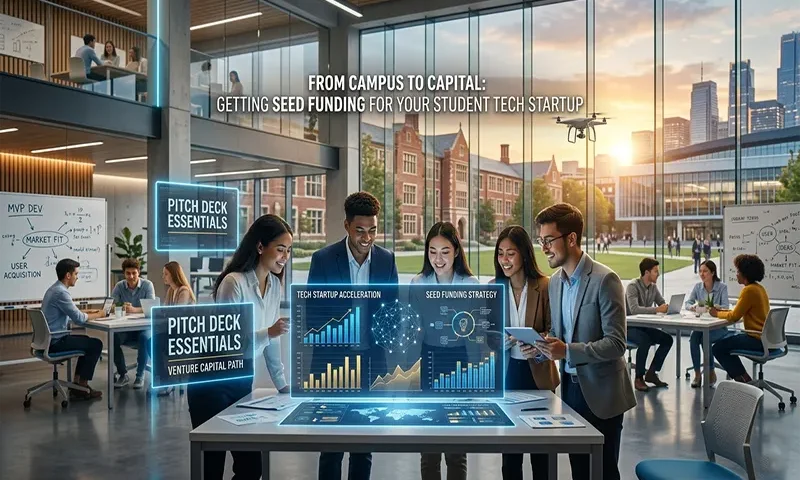
In 2026, the venture capital landscape has shifted from “growth at all costs” to “efficient orchestration.” For student founders, this is the best environment in decades. The rise of Agentic Lean—the ability to build complex systems with tiny teams and AI agents—means that a dorm-room startup can now achieve in six months what used to take a Series A company two years.
However, investors are also more discerning. They are looking for “Traction over Pedigree.” It no longer matters if you attend an Ivy League or a local technical college; what matters is your ability to execute, your compliance with new digital mandates, and your path to profitability.
Here is your strategic guide to securing seed funding in the 2026 ecosystem.
1. The 2026 Seed Landscape: The Rise of “Micro-Seed”
The standard “Seed Round” has fragmented. Most student founders now start with a Micro-Seed (between $100k and $500k). These rounds are designed to prove one thing: Product-Market Fit (PMF) through Efficiency. Investors in 2026 are specifically hunting for “Agent-Native” startups—companies built from the ground up to utilize AI agents for operations, allowing for a low burn rate and high margins. If you can show that you are building a million-dollar business with only three humans, you are already ahead of 90% of the field.
2. Phase 1: The Non-Dilutive Layer (Free Money)
Before you give away equity, you must exhaust non-dilutive funding. This is capital that doesn’t require you to give up a piece of your company.
University-Backed Innovation Grants
By 2026, almost every major university has an “Innovation Fund.” These grants (typically $5k–$25k) are often equity-free.
- The Strategy: Use these to pay for your API credits, server costs, and legal incorporation.
- Pro-Tip: Check if your school has a “Social Impact” or “Green Tech” fund; these often have lower competition and higher grant amounts.
The Competition Circuit
Pitch competitions have evolved into a professional circuit. Winning a regional or national competition (like the Global Student Entrepreneur Awards) provides more than just cash; it provides the “Social Proof” that professional VCs look for during due diligence.
3. Phase 2: The “Student-First” VCs and Alumni Angels
Once you have a working MVP and initial traction, it’s time to look for institutional capital.
- Student-Focused Funds: Firms like Dorm Room Fund, 1517 Fund, and First Round’s Student Program specifically invest in founders who are still in school. They understand that your “lack of experience” is actually a “lack of bias,” allowing you to solve problems in ways incumbents can’t.
- Alumni Angels: Your university’s alumni network is your warmest lead source. Use LinkedIn to find alumni who are now VCs or successful founders.
- The Approach: “I’m a current [University Name] student building [Product]. I’d love 15 minutes of your time for a ‘Stress Test’ of my pitch.” (Note: Ask for advice, and you’ll often get money).
4. The 2026 Pitch Deck Essentials
The “Standard Deck” has changed. To get a check in 2026, you need to include these three critical slides that didn’t exist a few years ago:
The “AI Efficiency” Slide
Investors want to see your Human-to-Output Ratio.
- What to Show: “While a traditional competitor requires 15 developers, our Agentic Workflow allows us to maintain the same velocity with 2 founders and 4 autonomous agents.”
The “Compliance-Ready” Slide
As of April 2026, digital accessibility and AI safety are no longer “optional.”
- What to Show: Your roadmap for meeting the April 2026 EAA (European Accessibility Act) mandates and your protocol for “Human-in-the-Loop” AI safety. This proves you won’t be sued out of existence in six months.
The “N-of-1” Data Slide
What data do you have that an AI can’t just hallucinate? Show your proprietary data loops—the “moat” that keeps your AI from being replicated by a larger competitor.
5. Navigating the Legalities: Where to Incorporate?
Your legal structure is your foundation. In 2026, the choices are clearer:
- For US-Focused Startups: The Delaware C-Corp remains the gold standard for VC investment. It’s what 99% of US investors expect.
- For European-Focused Startups: The new EU Inc. (28th Regime) framework allows for 48-hour digital incorporation and harmonized rules across the EU. This is a massive “green flag” for European VCs looking for easy scalability.
6. The “Founder-Student” Pitch: Narrative is King
When pitching, don’t hide the fact that you’re a student—lean into it.
Investor Red Flags:
- “I’m doing this part-time”: Investors hate this. Tell them, “I am a founder first; my degree is my R&D phase.”
- “I don’t have a co-founder”: Solo founders are a harder sell. In 2026, having at least one partner (or a very sophisticated “Agentic Co-founder” setup) is preferred.
- “We’ll figure out the business model later”: In 2026, “Growth over Profit” is dead. Show a “Path to $1M ARR.”
7. Comparison: Seed Funding Sources (2026)
| Funding Type | Amount | Equity Taken | Best For… |
| University Grant | $5k – $25k | 0% | Prototypes & Legal setup |
| Pitch Competitions | $10k – $50k | 0% | Validation & Marketing |
| Angel Investors | $25k – $100k | 5% – 10% | Early “Warm” capital |
| Student VCs | $100k – $250k | 7% – 12% | Scaling to $1M ARR |
| Micro-VCs | $250k – $500k | 10% – 15% | Formalizing the team |
The 100-Day Roadmap
If you want a check in your bank account in 100 days, follow this:
- Days 1-30: Build your “Ghost Suite” MVP. Get 100 users (even if they are just fellow students).
- Days 31-60: Apply for every university grant and local competition. Use the “Free Money” to incorporate.
- Days 61-80: Build your “Investor CRM.” Reach out to 50 Alumni Angels for “Advice.”
- Days 81-100: Pitch. Iterate the deck after every “No” until you get your first “Yes.”
The 2026 economy doesn’t care about your age; it cares about your referential velocity—how fast you learn, build, and adapt. Go build something.

