
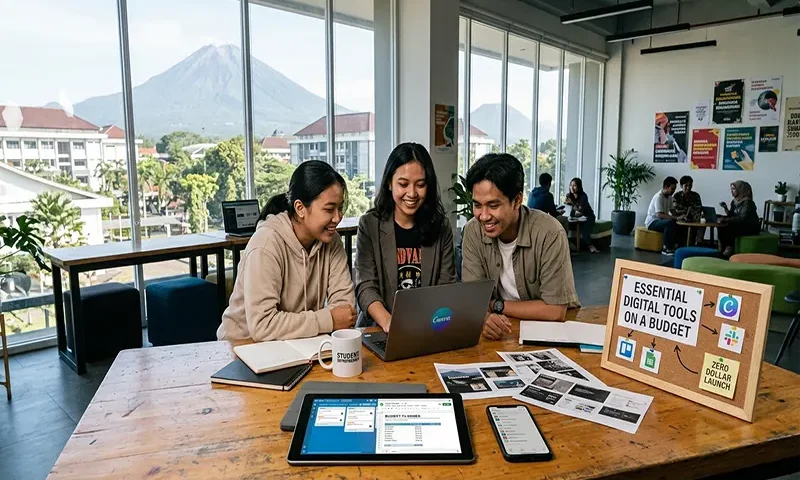
In 2026, the cost of starting a tech company has dropped to near zero, provided you know how to orchestrate the right “Freemium” stack. We have entered the era of the Solo-Agentic Founder—a student who can act as a CEO, Lead Developer, and Head of Growth simultaneously by linking free AI-driven tools into a cohesive “Ghost Suite.”
For the student founder, every dollar spent on a subscription is a dollar taken away from your morning coffee or your server credits. This guide breaks down the essential digital tools that allow you to build a professional, scalable startup for $0 to $100 total.
1. The $0 Founder Mindset: Bootstrap Orchestration
In 2026, the “Bootstrap Mindset” isn’t about doing everything yourself; it’s about making your tools do everything for you. The goal is to build a business that runs while you are sitting in a lecture. This is achieved through Interoperability—ensuring that your project management tool talks to your CRM, and your CRM talks to your social media scheduler.
2. The “Ghost Suite”: Operations & Automation
The “Ghost Suite” is the administrative backbone of your company. It handles the “noise” so you can focus on the “signal.”
- The Orchestrator: Make.com (Free Tier)
While Zapier is the industry standard, Make.com offers a more generous free tier for complex “branching” logic. Use it to link your email, your database, and your Slack.
- Budget Hack: Set up a “lead-gen bot” that scrapes mentions of a problem on social media and automatically adds them to your Notion database.
- The Project Hub: Notion
Notion is the “Second Brain” of the modern founder. For students, the Personal Pro plan is usually free with a .edu email.
- Strategic Use: Create a “Founder’s Dashboard” that tracks your 18-month rolling forecast, your pitch deck iterations, and your April 2026 compliance checklist.
3. The AI Co-Founder: Development & Research
You no longer need a technical co-founder to build a prototype. You just need the right AI agents.
- Coding for Non-Coders: v0.dev & Replit Agent
If you can describe a website or an app, v0.dev (by Vercel) can build the front end for you. Pair this with Replit Agent, which handles the back-end logic, and you can have a functional web app live in a single afternoon.
- Market Intelligence: Perplexity AI
Forget basic Google searches. Perplexity provides cited, real-time research. Use it to build your “Competitor Matrix” and to stay updated on the latest AI safety regulations.
- Budget Hack: Use the “Pro Discovery” mode to find niche B2B SaaS gaps that larger firms are ignoring.
4. The Brand Engine: Marketing & Design
In 2026, “Founder-Led Content” is the primary driver of growth. You need tools that make you look like a 10-person creative agency.
- High-End Visuals: Canva Magic Studio
Canva’s AI-powered “Magic Studio” allows you to generate professional logos, slide decks, and social assets from simple text prompts.
- Viral Video: CapCut (Desktop & Mobile)
Short-form video is the king of 2026 distribution. CapCut offers high-end features (like auto-captions and AI color grading) for free, allowing you to create TikTok/Reels content that looks professionally edited.
- The Distribution: Buffer (Free Tier)
Don’t post manually. Use Buffer to schedule your weekly content across LinkedIn, X, and Instagram in one sitting.
5. The Professional Front: Sales & Legals
A student startup must look like an enterprise to be treated like one.
- Getting Paid: Stripe Payment Links
You don’t need a complex checkout system. Create a Stripe Payment Link, drop it in your social bio or an email, and you can accept payments globally in minutes.
- Legal Basics: Open-Source Contracts
Instead of paying for a lawyer, use open-source repositories like Docracy or the Y-Combinator Library for NDAs and Service Agreements.
- Budget Hack: Always use the “Common Stock” or “SAFE” templates for early agreements to ensure you don’t mess up your cap table.
6. The “April 2026 Compliance” Check
Compliance is not just for big companies. In 2026, the European Accessibility Act (EAA) is in full force. Even as a student, if you are selling to EU customers, your site must be accessible.
- Free Audit Tools: WAVE & Axe
Use the WAVE Evaluation Tool (a free browser extension) to check your site for accessibility errors.
- Pro-Tip: Fixing “Alt-text” and “Contrast” issues now prevents $10,000+ fines later. Being “Accessible by Design” is a competitive advantage when pitching to enterprise “Link Partners.”
7. The 2026 Student Startup “Growth Ladder”
| Phase | Core Tool | Cost | Goal |
| Ideation | Notion + Perplexity | $0 | Build the Roadmap |
| Prototyping | v0.dev + Replit | $0 – $20 | Build the MVP |
| Distribution | CapCut + Buffer | $0 | Get 1,000 Users |
| Scaling | Make.com + Stripe | $0 (Trans. fees) | First $1k Revenue |
The Growth Ladder
The ultimate budget hack for 2026 is the GitHub Student Developer Pack. By verifying your student status, you get free access to Canva Pro, Name.com domain registration, DigitalOcean credits, and dozens of other “Pro” tools for free.
Final Strategic Advice:
Don’t fall in love with the tools; fall in love with the problem. Use these free digital agents to handle the “how,” so you can spend your limited time on the “who” (your customers) and the “why” (your vision). In 2026, the barrier to entry is gone—the only thing left is your willingness to click “Start.”

