
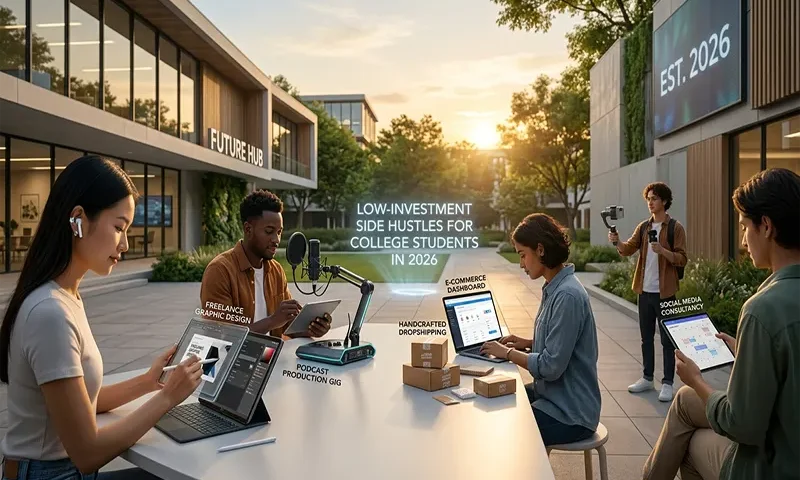
The “starving artist” trope of the college experience is officially being disrupted. In 2026, the traditional part-time job—punching a clock at a campus cafe or folding shirts at the mall—is being replaced by the “Poly-Hustle.” Driven by the maturity of AI agents, a booming creator economy, and new federal digital mandates, students are now building micro-businesses from their dorm rooms that offer higher hourly rates and future-proof professional skills.
If you have a smartphone, a laptop, and less than $100 in your bank account, the barrier to entry has never been lower. Here are the top low-investment side hustles for college students in 2026.
1. The AI-Assisted Creator: High-Volume Output, Low Effort
By 2026, generative AI isn’t just a novelty; it’s a standard operating tool. Students who know how to “co-pilot” with AI are out-earning those who do everything manually.
UGC (User-Generated Content) Specialist
Brands in 2026 have moved away from polished, expensive commercials toward “authentic” short-form video. As a student, you are the target demographic. Brands will pay you to create 15–30 second clips of you using their products.
- Startup Cost: $0 (Use your phone and free versions of CapCut or Adobe Express).
- Pro-Tip: Focus on “unboxing” or “day-in-the-life” styles. Brands value the aesthetic of a real dorm or campus backdrop.
Prompt Engineering & AI Tutoring
While many know of AI, few know how to use it effectively for complex tasks. You can offer services to local small businesses or even fellow students to help them set up automated workflows, custom GPTs for study aids, or AI-driven social media calendars.
- Startup Cost: $20/month for a premium AI subscription.
- Pro-Tip: Market yourself as an “Efficiency Consultant.” Help a local shop automate their customer FAQs to save them five hours of work a week.
2. Specialized Digital Services: The “Mandate” Goldmine
2026 is a year of significant regulatory shifts, specifically in how the internet is used. Savvy students are positioning themselves to solve these new “compliance” headaches for businesses.
Digital Accessibility Consultant
As of April 2024, the Department of Justice finalized new ADA mandates requiring public-sector websites (and many businesses serving them) to meet strict WCAG 2.1 Level AA accessibility standards. Thousands of organizations are currently scrambling to meet these requirements.
- How it works: Learn the basics of alt-text for images, screen-reader compatibility, and color contrast. Use free audit tools to identify errors on local government or small business sites and offer to fix them.
- Startup Cost: $0 (Learning resources are free via W3C).
Micro-Niche Community Manager
The era of the “giant social network” has fragmented into “micro-communities.” Businesses are moving their audiences to platforms like Discord, Skool, or Substack. They need moderators who understand the culture and can keep the community engaged.
- Startup Cost: $0.
- Pro-Tip: Specialize in a niche you already love, such as gaming, sustainable fashion, or fitness, to provide more value than a general VA.
3. The “Circular” Physical Hustle: Profit with a Purpose
Sustainability is the defining value of 2026. Students are finding that “circular” business models—keeping products in use longer—are both profitable and popular.
Resale Arbitrage & Upcycling 2.0
Thrifting is no longer just about finding cool clothes; it’s about curated resale. Using 2026’s advanced resale apps that utilize AI for instant pricing and authentication, you can flip thrifted “eco-fashion” or vintage tech.
- Startup Cost: $20–$50 (Your first few inventory items).
- Pro-Tip: Look for “deadstock” or repairable tech. A 2020 tablet with a cracked screen can often be fixed with a $15 part and a YouTube tutorial, then resold for a $100 profit.
4. Scaling & Ethics: The Student-Founder Balance
While the allure of “side hustle income” is strong, your primary “job” is still your degree.
The Ethics of AI
In 2026, the line between “using AI as a tool” and “academic dishonesty” is sharper than ever. Never use your side-hustle AI workflows to generate your class assignments. Keep your professional tools and your academic tools strictly separate to avoid jeopardizing your degree.
Time Management
The key to the Poly-Hustle is asynchronous work. Choose hustles that don’t require you to be “on-call” during your 10:00 AM lecture. UGC creation and Digital Accessibility audits are perfect because they can be done at 2:00 AM on a Sunday if that’s when you’re free.
Summary: 2026 Hustle Comparison Table
| Side Hustle | Startup Cost | Potential Hourly | Skill Level |
| UGC Creator | $0 | $50 – $150 | Low (Creativity focus) |
| Accessibility Consultant | $0 | $40 – $100 | Medium (Technical) |
| AI Prompt Tutor | $20 | $30 – $75 | Medium (Tool-specific) |
| Community Manager | $0 | $20 – $40 | Low (Social focus) |
| Tech/Fashion Upcycler | $50+ | Variable | Medium (Manual/Sales) |
The 2026 Startup Toolkit
To get started today for under $100, download these essentials:
- Notion: (Free) To manage your clients and project timelines.
- Canva: (Free/Pro) For quick brand graphics and UGC overlays.
- WAVE or Axe DevTools: (Free) For running your first accessibility audits.
- A Separate High-Yield Savings Account: Keep your “hustle tax money” separate from your “pizza money.”
The 2026 economy doesn’t reward those who wait for a graduation ceremony to start their career. It rewards the students who are willing to experiment, use the tools at their fingertips, and solve the immediate problems of the digital world. Which one will you start tonight?

