
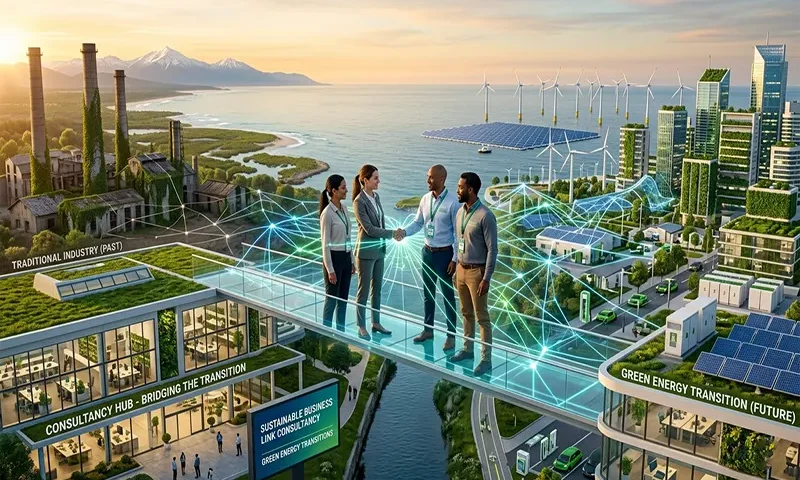
By early 2026, the corporate world has moved past the era of “Greenwashing.” High-profile regulatory fines and the implementation of the April 2026 Carbon Border Adjustment Mechanism (CBAM) have turned sustainability from a marketing buzzword into a critical operational mandate. However, a significant “Execution Gap” remains: while 80% of global enterprises have pledged to transition to net-zero, fewer than 15% have the technical infrastructure to actually link renewable energy sources to their legacy business systems.
This friction has given rise to the Sustainable Business Link Consultancy. These firms act as the specialized connective tissue between the decentralized world of green energy (DERs) and the centralized, data-heavy world of the modern enterprise. They are the architects of the “Twin Transition”—the simultaneous leap toward a digital and a decarbonized future.
1. The Integration Gap: Why Decarbonization Fails
The primary barrier to the green transition in 2026 isn’t a lack of solar panels or wind turbines; it is the Interconnectivity Deficit. A manufacturing firm might install an onsite microgrid, but if that microgrid cannot “talk” to the company’s ERP system, the energy is wasted, and the carbon data is lost.
Sustainable Link Consultancies solve this by creating a Unified Energy Foundation. They ensure that every watt of green energy generated or purchased is tracked, verified, and optimized in real-time. Without this “Link,” companies are left with “orphaned green assets”—technologies that look good on a sustainability report but fail to reduce actual operational carbon intensity.
2. The Role of a Sustainable Link Consultancy
A Sustainable Link Consultancy is fundamentally different from a traditional environmental consultant. While the latter might suggest what to buy, the Link Consultant builds the system that makes it work.
Grid-to-Enterprise Orchestration
In 2026, the energy grid is no longer a one-way street. Companies are now “Prosumers”—both consumers and producers of energy. Link Consultancies build the software bridges that allow a factory to automatically switch from grid power to its own battery storage when prices spike or when the grid carbon intensity is high.
Data Integrity & Green Provenance
With the April 2026 mandates for “Green Claims” transparency, companies can no longer rely on vague estimates. Link Consultancies implement Proof of Origin protocols. By linking energy meters directly to blockchain-backed ledgers, they provide an unalterable audit trail of “Green Provenance,” ensuring that a “zero-carbon” product is truly what it claims to be.
3. Core 2026 Technologies for Transition
The toolbox for the green transition has evolved into an ecosystem of autonomous, predictive systems.
Digital Twins of Energy Flow
Link Consultancies utilize high-fidelity Digital Twins to simulate a company’s entire energy footprint. By creating a virtual mirror of a production facility, consultants can run “What-If” scenarios: How would our margin change if we transitioned 60% of our logistics to hydrogen-electric by August? This allows for risk-free experimentation before capital is deployed.
Agentic Energy Markets
The breakthrough of 2026 is Agentic Grid Orchestration. Link Consultancies deploy autonomous AI agents that live within the company’s energy management system. These agents monitor weather patterns, grid pricing, and production schedules to autonomously buy, store, and sell energy.
- Example: If a corporate office in Barcelona predicts a sunny afternoon, the AI agent can sell the building’s excess solar battery capacity back to the grid at peak pricing, turning the building into a revenue center.
4. The Regulatory Catalyst: April 2026 and Beyond
The timing of this transition is not accidental. Several key mandates have converged this month, making Link Consultancies a mechanical necessity for global trade.
- CBAM Enforcement: The Carbon Border Adjustment Mechanism now requires real-time reporting of the embedded carbon in products imported into the EU. Link Consultancies automate the “Link” between foreign suppliers and the importer’s reporting portal.
- The Digital Accessibility Link (EAA): Often overlooked in the green space, the April 2026 EAA mandates require all sustainability dashboards and customer energy portals to be fully accessible. Link Consultancies ensure that “Green Transition” interfaces are usable by everyone, preventing a “Sustainability-Accessibility Gap.”
5. The “Circular Link” Framework
True sustainability goes beyond energy. Link Consultancies are increasingly focusing on the Circular Economy—linking the “End-of-Life” of a product back into the “Beginning-of-Production.”
This involves building data links between waste management providers and procurement departments. If a consultancy can link a manufacturer to a reliable stream of recycled polymer through an automated data exchange, the manufacturer can reduce their “Scope 3” emissions significantly without changing their core product design.
6. Measuring the “Green ROI”
The way we measure sustainability has shifted from “Spend” to “Intensity.”
| Transition Phase | Focus | Primary Metric |
| Phase 1: Compliance | “Do no harm” / Reporting | Total Carbon Footprint |
| Phase 2: Efficiency | Energy Reduction | Energy per Square Foot |
| Phase 3: Linked | Systemic Orchestration | Carbon Intensity per Unit of Revenue |
| Phase 4: Circular | Waste Integration | Resource Recirculation Rate |
Strategic Imperative: In 2026, investors value Carbon Decoupling—the ability to grow revenue while simultaneously decreasing carbon intensity. This is only possible through the deep system integration provided by Link Consultancies.
7. The Connected Green Enterprise
The future of business belongs to the “Connected Green Enterprise.” Transitioning to sustainable energy is no longer an act of altruism; it is an act of Operational Resilience. As the climate becomes more volatile and the regulatory environment more stringent, the companies that thrive will be those that have successfully “linked” their growth to a renewable foundation.
Final Strategic Advice for 2026:
If you are still treating sustainability as a “department,” you are behind. It must be an “architecture.” The role of the Sustainable Business Link Consultancy is to ensure that when you flip the switch on your green transition, the entire enterprise lights up.

