
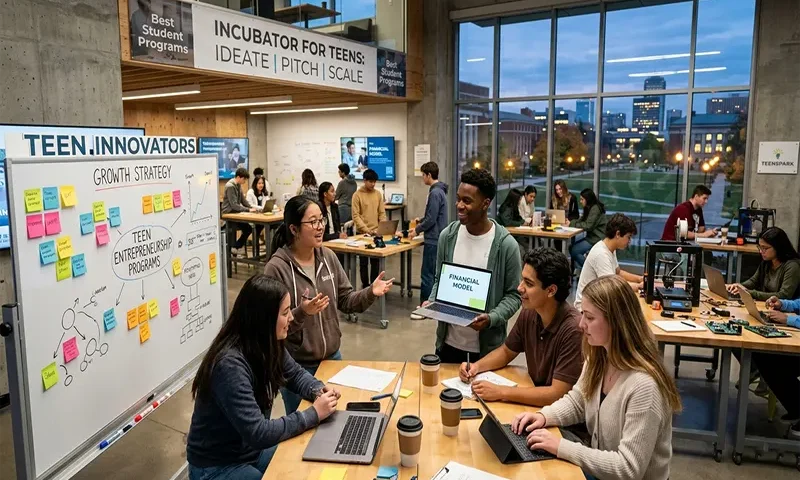
In 2026, the traditional path of “wait until graduation to start a career” has been completely upended. We are witnessing the rise of the Pre-College Founder. Armed with agentic AI, no-code prototyping tools, and a global digital network, today’s teenagers are building venture-backed startups before they even receive their high school diplomas.
For the ambitious teen, a standard summer job no longer cuts it. The new “gold standard” is securing a spot in an elite entrepreneurship incubator. These programs don’t just teach business theory—they provide the “Founder’s Toolkit”: mentorship from Silicon Valley veterans, access to seed funding, and a peer network of future world leaders.
1. The Rise of the Teen Founder: Why Now?
Age is no longer a barrier to entry; it is a competitive advantage. In 2026, “Gen Alpha” and Gen Z founders are leveraging three specific shifts:
- The “Zero-Cost” Stack: Using AI agents to act as fractional developers, marketers, and researchers.
- The Reputation Economy: Proof of Work (what you’ve built) has replaced the GPA as the most valuable currency for top-tier universities and investors.
- Radical Connectivity: A 16-year-old in Singapore can co-found a climate-tech startup with a peer in London via virtual hacker houses.
2. Top Global Incubators for Teens
The Knowledge Society (TKS) | The Global Human Accelerator
TKS is arguably the most prestigious year-long program for students aged 13–17. Rather than just “business,” TKS focuses on Emerging Technologies (Quantum Computing, Synthetic Biology, AI) and “Moonshot Thinking.”
- Program Highlight: Students work on “Challenges” for global giants like Google, Microsoft, and the UN, using First Principles thinking to solve real-world problems.
- Commitment: 10 months (September to June), weekly virtual or in-person sessions.
LaunchX | The Rigorous Startup Engine
Originally born at MIT, LaunchX is the “Ivy League” of summer entrepreneurship. It is famous for its “Zero-to-Launch” intensity.
- Program Highlight: In 2026, the San Diego Flagship Program allows students to live on a university campus and build a real company with customer sales in just four weeks.
- Key Stats: Over 11% of LaunchX teams achieve real revenue before the program ends.
BETA Camp | The Revenue-First Intensive
BETA Camp is designed for teens who want to understand the “business of tech.” It skips the academic fluff and goes straight to building revenue-generating products.
- Program Highlight: An emphasis on the “Growth Mindset” and professional networking. Alumni frequently land internships at unicorns like Stripe and OpenAI before they graduate high school.
- Commitment: 4-week summer intensive.
3. Specialized Niche Programs
Climate Catalysts Programme (UNDP + Microsoft)
For teens focused on the “Green Transition,” this fellowship (active in the Asia-Pacific region for 2026) supports youth-led solutions in renewable energy and circular economy models.
- Focus: Turning environmental ambition into investment-ready climate-tech startups.
ESSEC Youth Entrepreneurship Bootcamp
Held at ESSEC’s Africa campus (and virtually), this program is perfect for students looking for a European/Global perspective on leadership and creative problem-solving.
- Focus: Design Thinking and Public Speaking for the next generation of global CEOs.
4. What Makes a “Best-in-Class” Program?
When evaluating a program for 2026, look for these four “Proof Points”:
- Non-Dilutive Funding: Does the program offer “equity-free” grants or cash prizes (like the Creative Young Entrepreneur Competition)?
- Expert Mentorship: Are the “teachers” academic professors or actual founders who have exited companies?
- Legal & IP Support: Since many founders are minors, does the program help navigate the complexities of “EU Inc.” or LLC incorporation for under-18s?
- The “Alumni Lifetime Value”: Check the LinkedIn profiles of past participants. Are they at top-tier VCs, Ivy Leagues, or running their own firms?
5. How to Get In: The Founder Portfolio
Getting into TKS or LaunchX is often as competitive as getting into Stanford. To stand out in 2026, you need more than good grades.
- Build a “Micro-Hustle”: Show you’ve already tried something. Whether it’s a newsletter with 500 subscribers or a Chrome extension you built with AI, “built and failed” is better than “never tried.”
- Proof of Work: Create a personal website or a LinkedIn “Build in Public” series. Document your learning journey.
- The “T-Shaped” Profile: Have a broad understanding of business but a “Deep Dive” in one tech area (e.g., “I know marketing, but I am an expert in AI-driven SEO”).
6. Summary: 2026 Teen Incubator Comparison
| Program | Format | 2026 Cost (Est.) | Focus Area |
| TKS (Global) | 10-Month Virtual/Hybrid | $3,500 – $6,000 | Moonshot Tech & Personal Growth |
| LaunchX | 4-5 Week In-Person/Online | $1,995 – $11,495 | Rapid Startup Launch & Sales |
| BETA Camp | 4-Week Virtual | $2,000 – $3,500 | Revenue & Business Foundations |
| ESSEC Bootcamp | 1-Week In-Person (Africa) | ~9,000 MAD | Leadership & Design Thinking |
| Climate Catalysts | 8-Week Fellowship | Free (Selective) | Social Impact & Climate Tech |
The Parental Role: From Manager to Consultant
In 2026, the most successful teen founders have “Consultant Parents.” These are parents who provide the emotional and legal support (signing incorporation docs, providing a quiet space) without dictating the business strategy.
First Step for Teens: Don’t wait for a summer camp. Start by identifying one “Campus Friction” problem today and use a free AI agent to draft a solution. Your journey doesn’t start with an acceptance letter—it starts with a prototype.

