
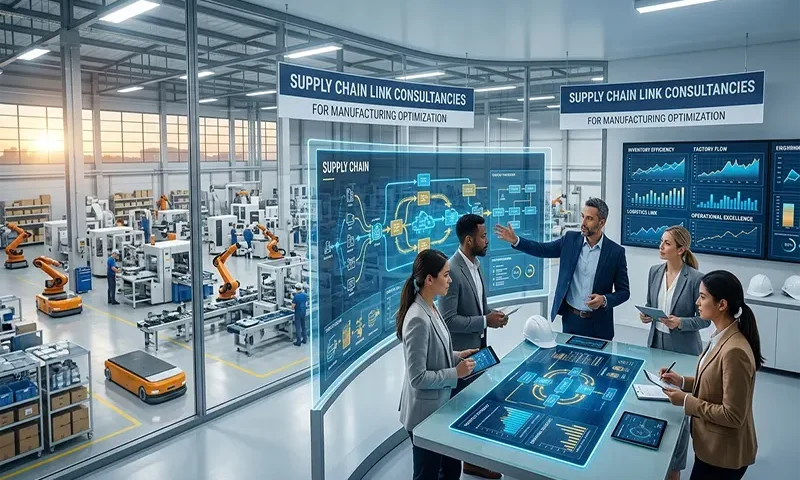
In 2026, the manufacturing sector is no longer defined by “Just-in-Time” or even “Just-in-Case” methodologies. We have entered the era of Permanent Volatility. Between the full activation of the EU’s Carbon Border Adjustment Mechanism (CBAM), intensifying geopolitical shifts, and a chronic shortage of skilled operational talent, the modern factory floor has become a high-stakes arena for data orchestration.
Traditional strategy firms provide the “what,” and software vendors provide the “how.” However, a new category of partner has become essential for survival: the Supply Chain Link Consultancy. These firms act as the central intelligence—the conductors—connecting the disparate silos of procurement, production, and logistics into a single, antifragile ecosystem.
1. The 2026 Manufacturing Reality: Beyond Resilience
For years, “resilience” was the goal—the ability to bounce back from a shock. In 2026, leading manufacturers aim for Antifragility. An antifragile supply chain doesn’t just survive a port closure or a sudden tariff; it uses the disruption to gain a competitive edge by adapting faster than its peers.
This shift is driven by the Twin Transition: the simultaneous demand for radical digitalization and total decarbonization. With the “EU Inc.” legal framework streamlining cross-border operations and the April 2026 digital mandates requiring full transparency, manufacturing optimization has moved from a back-office function to a core value driver.
2. What is a Supply Chain Link Consultancy?
A Link Consultancy is the bridge between high-level executive strategy and shop-floor execution. Unlike legacy consultants who deliver static reports, Link Consultancies focus on Connected Intelligence.
They specialize in integrating “N-Tier Visibility”—seeing not just your primary suppliers, but your suppliers’ suppliers—into your daily operational workflow. They don’t just recommend a new material; they orchestrate the legal, logistics, and technical links required to swap that material into production without stopping the assembly line.
3. The Three Pillars of 2026 Optimization
Pillar I: Agentic AI Orchestration
By 2026, AI has moved from “Chatbots” to “Agents.” In an optimized factory, specialized AI agents for material planning, demand forecasting, and commercial logistics collaborate autonomously.
- The “Conductor” Effect: If a shipment of semiconductors is delayed by a storm, your Material Planner Agent doesn’t just alert you; it communicates with the Commercial Agent to identify which customer orders can be delayed with the least penalty and triggers a production schedule change in the ERP—all within trusted human-in-the-loop guardrails.
Pillar II: Virtual Twin Execution (The Digital Rehearsal)
Optimization now happens in the “virtual universe” before a single machine is turned on. Link Consultancies deploy High-Fidelity Digital Twins that mirror real-world systems.
- Closed-Loop Planning: These twins allow for “digital rehearsals” of disruptions. Manufacturers can simulate the impact of a 50% spike in energy costs or a new carbon tax on a specific product line, allowing them to optimize for “Recovery Time Objective” (RTO) before the crisis hits.
Pillar III: Scope 3 Transparency & CBAM Compliance
As of 2026, carbon is a currency. The Carbon Border Adjustment Mechanism (CBAM) requires manufacturers to account for the embedded emissions of their imports.
- Strategic Takeaway: Link Consultancies automate this data collection across the value chain. By providing real-time carbon tracking, they turn ESG compliance from a bureaucratic burden into a margin advantage, allowing firms to choose suppliers based on “Total Carbon Value” rather than just unit price.
4. Operational Case Study: From Silos to Synchronicity
A mid-sized automotive component manufacturer was struggling with 12% “dead stock” and frequent production halts due to Tier-2 supplier failures. They engaged a Link Consultancy to move from Firefighting to Orchestration.
The consultancy linked the firm’s ERP directly to IoT sensor data from their top 50 suppliers. When a Tier-2 supplier in Southeast Asia reported a 48-hour power outage, the Agentic Orchestrator automatically rerouted a secondary shipment from a local “reshored” partner.
- The Result: The manufacturer reduced working capital by 15% and improved “Automation Accuracy” (the rate of autonomous planning decisions) from 20% to 74% within six months.
5. The 2026 ROI Metrics: The Total Value Model
The industry is moving away from the “Unit Price” obsession. Link Consultancies now evaluate success through the Total Value of Ownership (TVO).
| Metric | Legacy Manufacturing | 2026 Orchestrated Manufacturing |
| Primary Goal | Lowest Unit Cost | Total Value & Resiliency |
| Data Flow | Monthly S&OP Cycles | Continuous, Real-Time Planning |
| Visibility | Tier 1 Suppliers Only | Multi-Tier (N-Tier) Visibility |
| AI Role | Dashboards & Predictions | Agentic Execution & Orchestration |
| Sustainability | Qualitative CSR Reports | Quantitative CBAM & Scope 3 Data |
6. Building the Self-Healing Supply Chain
The manufacturers that will dominate the late 2020s are those that treat their supply chain as a dynamic, intelligent network rather than a series of disconnected links. Supply Chain Link Consultancies provide the expertise to transition from a reactive “crisis mode” to a proactive “orchestration mode.”
Strategic Takeaways for COOs:
- Move to “Human-Plus-Machine”: Invest in AI agents that augment your planners, rather than just replacing them.
- Prioritize Data Readiness: AI agents are only as good as the data they ingest. Clean, interoperable data is the precursor to scale.
- Reshore for Agility: In 2026, the cost savings of offshore production are often erased by the “Volatility Tax.” A Link Consultancy can help you balance global reach with local speed.
In a market defined by disruption, the most optimized link is the one that knows how to pivot before the break occurs. It’s time to stop firefighting and start conducting.

