
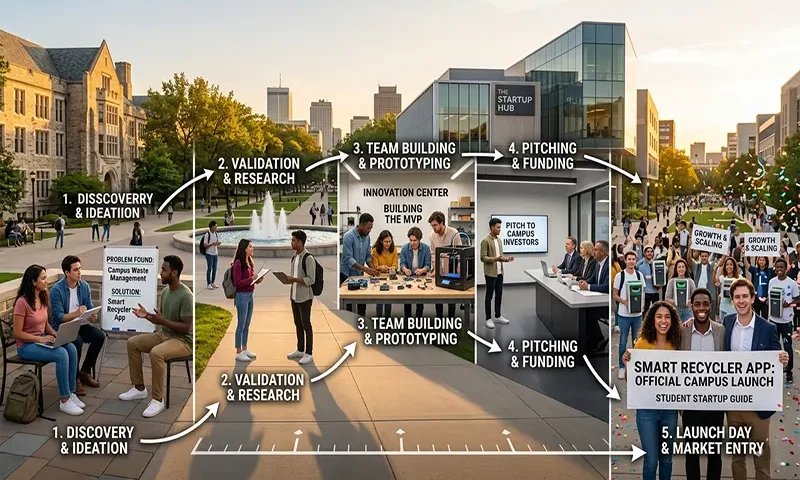
The “starving student” is a relic of the past. In 2026, the university campus has transformed into a high-octane launchpad where the barrier between a dorm-room idea and a global entity is thinner than ever. With the rise of Agentic AI, specialized university incubators, and new equity-free funding models, you no longer need a massive team or venture capital to disrupt an industry.
If you are looking to turn your academic career into a founder’s journey, follow this five-phase roadmap to launching your startup before graduation.
Phase 1: The Ideation Lab (Spotting Campus Friction)
The best student startups solve “Campus Friction”—problems that are invisible to the outside world but painful for 20,000 people living within a three-mile radius.
- Audit Your Day: Where do you waste time? Is it the archaic room-booking system? The lack of healthy late-night food? The difficulty of finding niche project partners?
- The “Problem-First” Filter: Avoid building a “cool app.” Instead, find a problem that people are already hacking a solution for. If students are using a messy Discord channel to trade textbooks, there is a gap for a dedicated, secure marketplace.
- Reality Check: Don’t fall in love with your first solution. In 2026, market needs shift weekly. Fall in love with the problem.
Phase 2: Building Your “Ghost Suite” (The MVP)
In 2026, a “Minimum Viable Product” (MVP) doesn’t require a computer science degree. You can build a “Ghost Suite”—a functional backend run almost entirely by AI agents.
- Agentic Co-Founders: Use platforms like Kore.ai or Sierra to deploy specialized agents. One agent can handle customer support, another can scrape market data, and a third can manage your social media outreach.
- No-Code Prototyping: Use tools like Bubble or FlutterFlow to build the front end. Your total startup cost should be under $50 (the cost of a domain and a few API credits).
- The 48-Hour Rule: If you can’t build a functional version of your idea in 48 hours using AI, the scope is too big. Strip it down until it does one thing perfectly.
Phase 3: Leveraging the “Invisible Campus”
Your tuition is more than a fee for classes; it is a subscription to a massive resource pool. Most students leave 90% of this “Invisible Capital” on the table.
The “Professor Pivot”
Stop viewing office hours as a place to ask about grades. Use them as advisory board meetings. Faculty members are often world-class experts with deep industry networks.
- Pro-Tip: Ask, “I’m building a prototype for [Problem]. Who in your network should I show this to?”
Makerspaces and Labs
In 2026, campus makerspaces are equipped with industrial 3D printers, VR testing suites, and even biotech “wet labs.” These are essentially free R&D facilities that would cost a private startup thousands in monthly rent.
Equity-Free Funding
Look for Non-Dilutive Grants. Many universities now offer “Innovation Micro-Grants” ($500–$5,000) that give you cash without taking a percentage of your company. In 2026, federal programs like SBIR Phase III are also more accessible to student-led research projects.
Phase 4: Viral Campus Marketing (Ground-Zero Growth)
Your campus is a “walled garden”—a high-density, high-trust environment perfect for rapid testing.
- The Discord/Slack Infiltration: Don’t spam. Provide value. If you’re launching a tutoring app, share a free, AI-generated study guide in the class channel first.
- Physical Activations: In a digital world, physical presence stands out. Use QR codes on high-traffic areas (the gym, the library, the coffee shop) that lead to a “beta-tester only” reward.
- Student Influencer Loops: Partner with the heads of student organizations. Offer their members early access or a “founder’s discount” in exchange for a shoutout.
Phase 5: The Legal & Academic Balance
This is where most student founders trip up. As you scale, you must navigate the “Hidden Rules” of the university.
The Intellectual Property (IP) Trap
Warning: Most universities have a policy stating that if you use “substantial university resources” (labs, staff time, or significant funding), the university owns a portion of your IP.
- The Safe Zone: Usually, if you build your startup on your own laptop, in your dorm, using only the campus Wi-Fi, you retain 100% ownership. Always check your university’s IP Policy 2026 handbook before scaling.
The “EU Inc.” Transition
By your junior or senior year, if you have revenue, consider formalizing the business. In 2026, the “EU Inc.” (28th Regime) framework allows you to incorporate digitally in 48 hours, making it easier to accept international payments or hire student freelancers across borders.
The Graduation Exit Strategy
By the time you walk across the stage, you should have more than a diploma—you should have an asset. Whether you choose to pursue the startup full-time or use it as a “super-resume” to land a Tier-1 job, the skills you gained as a campus founder are your real degree.
The Student Founder’s Resource Stack (2026)
| Category | Recommended Tool | Purpose |
| Productivity | Notion + AI | Project management and documentation. |
| Development | FlutterFlow | Building high-end mobile apps with no code. |
| Automation | Zapier Central | Connecting AI agents to your live data. |
| Funding | Grants.gov / Campus Lab | Finding equity-free student grants. |
| Legal | Clerky / EU Inc. Portal | Fast, low-cost incorporation. |

