

Why India’s Mid-Cap Companies Are Emerging as the Smartest Long-Term Investment Opportunity on the Bombay Stock Exchange
Successful investing rarely comes from chasing the largest corporations or gambling on the smallest businesses. In India’s equity market, the most rewarding opportunities often lie between those two extremes. Mid Cap Stocks have consistently demonstrated an exceptional ability to combine business stability with meaningful expansion, making them an attractive choice for investors seeking sustainable long-term wealth creation.
While blue-chip companies generally offer reliability, their mature business models and premium valuations can limit future upside. At the opposite end, small-cap firms may promise explosive growth but frequently carry higher volatility, lower liquidity, and greater governance concerns. Mid-cap businesses occupy the middle ground, balancing proven operations with substantial room to grow.
For investors monitoring BSE share price movements, this segment has repeatedly showcased businesses capable of delivering impressive returns through disciplined execution, improving profitability, and steady earnings growth across multiple market cycles.
The Mid-Cap Advantage: Stability Meets Expansion
India’s market regulator classifies … More >>>


Financial Forecasting Models for Scaling Sustainable Business Growth
In the high-stakes financial landscape of April 2026, the traditional distinction between “financial performance” and “sustainability” has officially dissolved. We have entered the era of Regenerative Orchestration, where a company’s valuation is no longer just a multiple of its EBITDA, but a reflection of its Recursive Resource Efficiency.
For high-growth firms, the “Static Annual Budget” has become a liability. In an economy governed by the newly enforced EU Omnibus simplifications and the April 2026 Digital Accessibility (EAA) mandates, scaling sustainably requires a new generation of forecasting models: those that treat carbon, social impact, and regulatory compliance as real-time financial variables.
1. The 2026 Capital Reckoning: The Alpha of Sustainability
The “Green Premium” of the early 2020s has evolved into a “Resilience Requirement.” In 2026, institutional investors use Sustainability-Linked WACC (Weighted Average Cost of Capital) models. Companies that cannot demonstrate a clear “Decoupling” of revenue growth from carbon intensity … More >>>

Sustainable Business Link Consultancies for Green Energy Transitions
By early 2026, the corporate world has moved past the era of “Greenwashing.” High-profile regulatory fines and the implementation of the April 2026 Carbon Border Adjustment Mechanism (CBAM) have turned sustainability from a marketing buzzword into a critical operational mandate. However, a significant “Execution Gap” remains: while 80% of global enterprises have pledged to transition to net-zero, fewer than 15% have the technical infrastructure to actually link renewable energy sources to their legacy business systems.
This friction has given rise to the Sustainable Business Link Consultancy. These firms act as the specialized connective tissue between the decentralized world of green energy (DERs) and the centralized, data-heavy world of the modern enterprise. They are the architects of the “Twin Transition”—the simultaneous leap toward a digital and a decarbonized future.
1. The Integration Gap: Why Decarbonization Fails
The primary barrier to the green transition in 2026 isn’t a lack of solar … More >>>
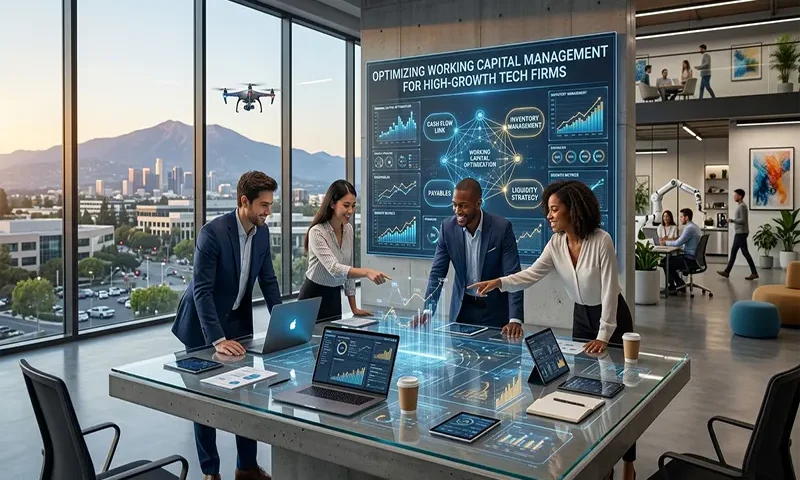
Optimizing Working Capital Management for High-Growth Tech Firms
In the high-velocity economic landscape of 2026, many tech firms are discovering a painful truth: growth is a cash-hungry machine. As companies scale from $20M to $100M in ARR, they often fall into the “Growth Paradox”—where soaring revenue on the income statement masks a looming liquidity crisis on the balance sheet.
For a modern tech firm, working capital is no longer just about managing “mops and buckets” or physical widgets. It is about managing Digital Float: the gap between paying for massive AI compute clusters and receiving payment from enterprise clients who still insist on Net-90 terms. To survive 2026, CFOs must transition from manual cash-flow tracking to Agentic Treasury models that optimize every dollar in real-time.
1. The High-Growth Paradox: Why Paper Profits Fail
In 2026, the delay between “booking a deal” and “cashing the check” has widened for enterprise tech. Large-scale buyers have implemented more rigorous … More >>>

Essential Digital Tools for Student Entrepreneurs on a Budget
In 2026, the cost of starting a tech company has dropped to near zero, provided you know how to orchestrate the right “Freemium” stack. We have entered the era of the Solo-Agentic Founder—a student who can act as a CEO, Lead Developer, and Head of Growth simultaneously by linking free AI-driven tools into a cohesive “Ghost Suite.”
For the student founder, every dollar spent on a subscription is a dollar taken away from your morning coffee or your server credits. This guide breaks down the essential digital tools that allow you to build a professional, scalable startup for $0 to $100 total.
1. The $0 Founder Mindset: Bootstrap Orchestration
In 2026, the “Bootstrap Mindset” isn’t about doing everything yourself; it’s about making your tools do everything for you. The goal is to build a business that runs while you are sitting in a lecture. This is achieved through Interoperability… More >>>